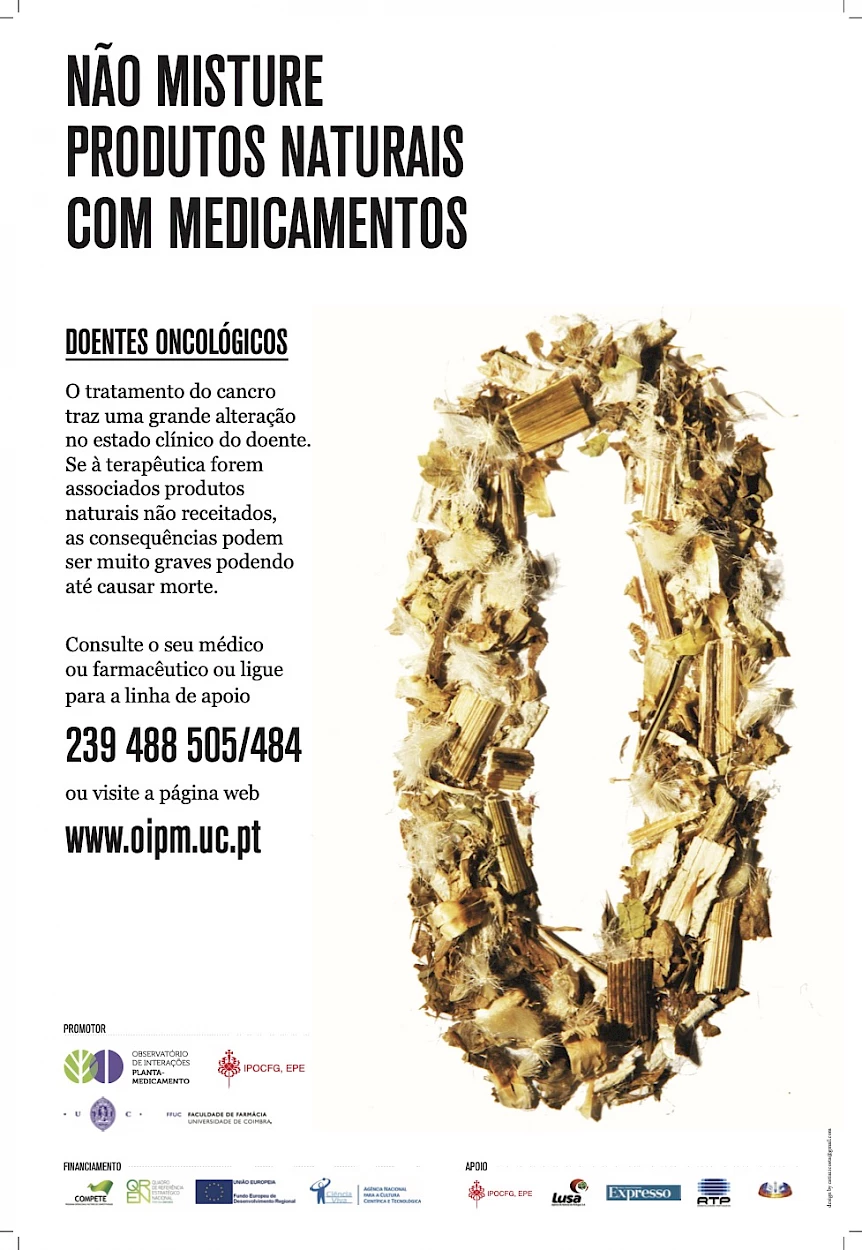

“Learning Health between Plants and Medicines” | Oncology Patients
The Observatory of Plant – Medicine Interactions (OIPM/FFUC) has a research group associated with the “IciPlant – Interactions between Cytostatics and Plants” Project since 2009 and takes place between the Faculty of Pharmacy of the University of Coimbra and the Portuguese Institute of Oncology of Coimbra “IPOCFG, E.P.E.”.
This content is being served from an external source and is not available because cookies have not been accepted.
Here is what you can do:
With the initial title “Research on interactions between cytostatics and bioactive molecules of natural origin (plant-based extracts) with affinity for the same CYP450 isoenzymes”, this project is developed in partnership with oncology doctors and has helped several cases of interactions with a serious toxicity outcome that were flagged.
OIPM/FFUC supports not only this Hospital Unit but also all those who need its support in this scientific area. Across the country, several patients were monitored by the team, which in addition to contributing to the analysis of plant-medicine interactions also analyzes products brought by patients.
Patients also contact OIPM directly to better understand these issues and to be able to make informed decisions about the information, or lack thereof, that exists about the natural products they are taking or that are recommended to them to treat cancer, stimulate the immune system and/or or to detoxify.
The OIPM, within the scope of the Project “Learning Health between Plants and Medicines” / Compete Ciência Viva/QREN, brings citizens an exclusive alert this week about products that patients mix with oncology treatments and that have caused serious problems health in Portugal and other countries.
The OIPM informs that the interactions between these two groups, medicines and natural products, are of the same type as those that occur between medicines (drug-drug interaction) or between plants (plant-plant interaction) and are classified as Pharmacokinetic and/or Pharmacodynamic . Briefly, Pharmacokinetic Interactions range from absorption to excretion, through distribution and metabolization (involving various types of enzymes that help detoxify the body). Pharmacodynamic interactions translate into an additive, synergistic or antagonistic effect.
In practice, what happens is that the effect of the medicine can be reduced if absorption or distribution is reduced. There is a reduction in absorption whenever seeds (e.g. flax, psyllium, chia), algae or fiber are consumed together with the medicine. Furthermore, some medications require proteins that transport them and if these are inhibited, as is the case with P-glycoprotein when taking St. John's wort, the medication may not reach the blood in sufficient quantities to be effective at the recommended dose.
The duration of a medication in our body is also reduced when renal excretion is stimulated, as happens with the use of plants with diuretic activity (for example, snake basil, artichoke, celery, dandelion, horsetail) .
On the other hand, plants such as St. John's wort, also known as St. John's wort, American ginseng (especially its metabolites released in the intestine), artichoke, milk thistle, salvia miltiorrhizae (danshen), among many others, increase the enzymatic metabolism of some medications. , reducing the amount of these medicines available to exert their therapeutic activity. This happens because these plants can induce the enzymes 2B6, 2C9, 2D6 and 3A4 of cytochrome 450 (CYP450), the most involved in the metabolization of medicines and many chemical substances that exist in plants. Reducing the available dose of the medication may lead to ineffective treatment, which could lead to continued proliferation of the tumor process.
However, there are medicines that we call pro-drugs and only after this first phase of metabolism do they become the medicine itself (as is the example of irinotecan). If the metabolism of the enzyme in question is inhibited, the medicine will never be transformed into the active version, and therefore the therapeutic effect will never be generated.
Situations in which the toxicity of some medications increases occurs through the opposite mechanism, that is, if absorption is increased or if the enzymes are inhibited and no longer exert their full activity in metabolizing the medication, as expected in the treatment. Examples of this activity are plants such as licorice, fresh garlic, aloe, Goji berries, milk thistle, horse chestnut, angelica (dong quai), gingko, Asian ginseng (its metabolites), hydraste, kava-kava, mangosteen, propolis, grape seed extract, grapefruit juice, valerian and vinca.
The World Health Organization (WHO) has directives that require that any and all Traditional Medicine products, based on plants, intended for the treatment of any disease, must present evidence of efficacy and safety and be prepared in light of Good Production Practices and Quality Control, which does not always happen. It also warns against counterfeiting and poor quality of several of these products, for the safety of patients who consume them. The WHO has received several reports of adverse effects with products of natural origin and the Food and Drug Administration (FDA) in the United States as well.
In Portugal, the OIPM/FFUC will receive these notifications, which will then be forwarded to other competent bodies in these areas depending on whether it is a supplement, food or medicine.
“Unfortunately, a series of products have appeared on the international market and also in Portugal, including “Miracle Plants” and equally DANGEROUS ones, in prevention and treatment, ranging from A to Z. In addition to the ones that cause interactions already mentioned, there are other which, in addition to also altering the bioavailability of medicines, such as turmeric (turmeric, echinacea, morinda (oilwood), noni, arcowood, soy, white mistletoe and Ziziphus jujuba Mill ( Chinese jujube), some of which are quite toxic.
In the last 30 years, around 124 cancer medicines have entered the market, of which only 20 are completely chemically synthesized. All the others, more than 100, come from natural products. These chemical substances taken from nature are active enough to help kill tumor cells, but they are properly controlled and used in doses that allow the benefit to exceed the risk, which is one of the main reasons why plants should not be used directly. because the sick person could be killed instead of saving him. The use of plant extracts is only safe if they are prepared with strict quality control and the doses of the constituents are properly determined. And these products must be duly registered with the respective entities depending on the category to which they belong.
Accidents in surgery are some of the most serious and can be fatal when some types of natural products have been consumed in advance, both because some of these products increase metabolism and can block transport proteins, for example, of anesthetics to the brain, or on the contrary increase the anesthesia time, if there are not enough carriers (because they were inhibited by the continued consumption of some plants) and therefore the elimination of anesthesia becomes longer, with risks for the patient. Increased bleeding time, clotting difficulties, changes in sedation and blood pressure are some examples. Rejection of organs due to taking plants in the previous weeks that are, for example, inducers of the enzymes necessary for the metabolization of medicines, such as cyclosporine. Luísa Costa, researcher at OIPM/FFUC, Anabela Marques from the Department of Anesthesia at CHUC and FFUC teachers and researchers Margarida Castelo-Branco, and Maria da Graça Campos last year prepared tables of Plant – Drug interactions in the peri-operative period, which are in the validation phase by the international scientific community, to later be disseminated in Portugal and thus be able to help in the assessment of these situations before they can occur in a surgical environment, thus contributing to preventing the risk and improving health in our country.